
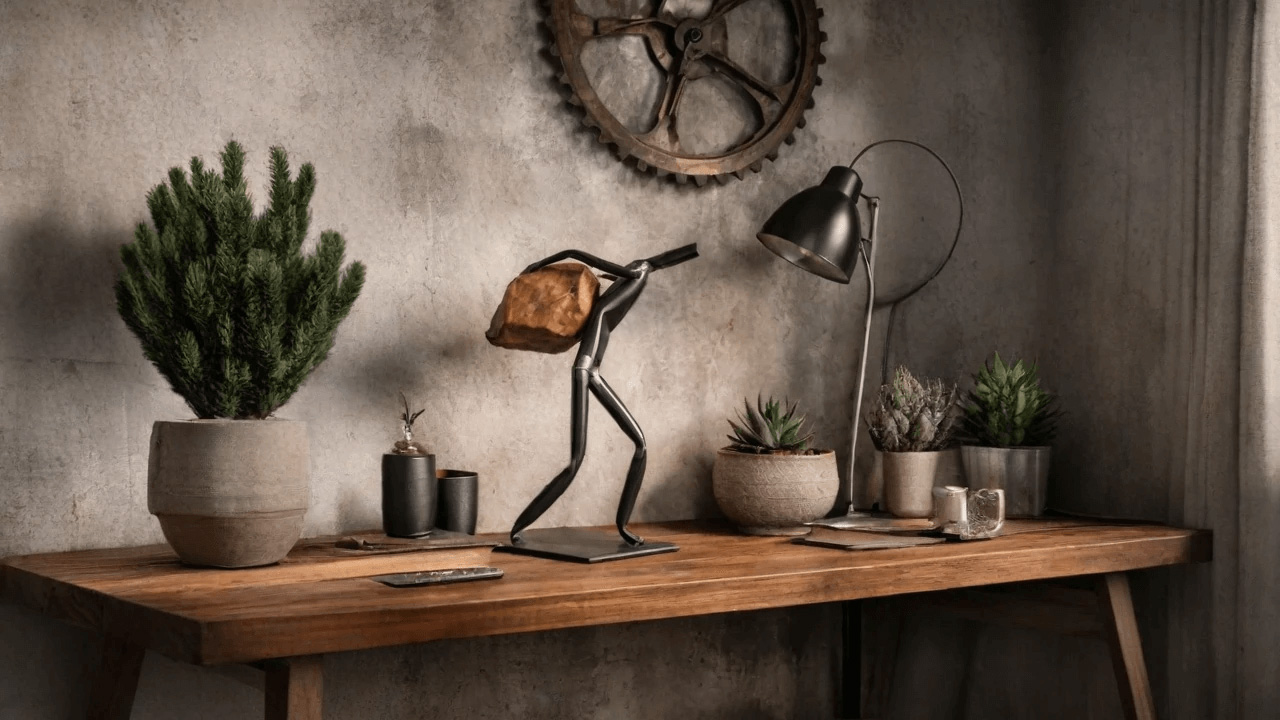
Discover how raw steel and iron sculptures are redefining contemporary architecture and interior design
There’s something honest about working with metal. When I started creating industrial metal art sculptures years ago, it began as a passion project—a way to escape the digital world and work with my hands. But honestly? It quickly became something deeper. I discovered I was using weight to define space.
As an artist working with iron, I’ve learned that heaviness isn’t just about physical mass. It’s about presence. It’s about anchoring a room, giving the eye somewhere to rest, and creating tension between what weighs tons and what feels almost weightless . And lately, I’ve noticed something exciting: architects and interior designers are paying attention.
The Rise of Metal in Contemporary Design
Metal in art has always carried industrial and urban themes, leaning closer to architecture and design than traditional fine art . But we’re seeing a shift. At Art Basel Hong Kong recently, visitors encountered stunning brass sculptures by Christopher K. Ho—an architect by training who digitally designs pieces before milling them from solid metal. His abstract forms shift as you walk around them, evoking everything from visionary city models to trophy collections .
This isn’t isolated. From Paris to Dallas, artists are exploring what metal can do. Oshay Green, a self-taught artist showing at the Nasher Sculpture Center, stacks scrap metal into towers using only gravity—no welding, no permanent attachment. His pieces echo both modernist sculpture and prehistoric monuments, all while being limited by his own physical reach. They become almost human .
Why Weight Matters in Defining Space
Richard Serra, the legendary sculptor who passed away recently, spent his career exploring this exact idea. He once said: “For me weight is an essential value… I know more about the heavy than about the light and therefore I have more things to say about it, more to say about the balance of weight, the reduction of weight, the addition and subtraction of weight” .
When you place a heavy metal sculpture in a space, something happens. The air around it changes. Serra’s works, like the monumental One-Ton Prop or Weights and Measures at the Art Institute of Chicago, aren’t fixed to the floor. They stand through balance alone—precarious, tense, alive . Walking around them, you feel your own body differently. You become aware of your weight, your balance, your place in the room.
That’s what I mean when I say I define space with weight. A well-placed iron sculpture doesn’t just occupy square footage. It creates a field of experience around itself .
The Architect’s Connection: From Prouvé to Today
There’s a rich history here. Jean Prouvé, the influential French designer and architect, believed there was “no difference between furniture and buildings” in their construction . He applied the same principles to everything from chairs to prefabricated houses, always working with metal, always respecting its structural logic.
When Gagosian Gallery paired Prouvé’s architectural models with John Chamberlain’s crushed-car-part sculptures, the dialogue was striking. Chamberlain called metal car components “art supplies” bending, crumpling, and welding them into colorful aggregations that read like three-dimensional brushstrokes . Raw industrial material transformed into pure expression.
Today’s artists continue this conversation. Sisan Lee, a Korean artist and interior designer, now leaves welding marks visible rather than sanding them smooth. Scratches become decorative. Heat discoloration becomes intentional. “These traces are material representations that distinguish the difference between design and art,” Lee explains .
What This Means for Your Projects
So why should architects and interior designers care about industrial metal art right now?
First, scale. Metal sculptures can be monumental or intimate. Brian Mock builds six-foot guitars from wrenches and gears weighing 100 pounds . Taiwanese artist Po-Chun Liu creates iron figures up to 40 tons, transforming industrial materials into “steel forests” that question our relationship with technology . Whatever your space, there’s a piece that can fill it.
Second, dialogue. Metal works speak to modern materials. They echo the steel in your structural columns, the iron in your railings, the aluminum in your window frames. But they also transcend function—becoming something purely aesthetic .
Third, that quality of presence I mentioned. A heavy sculpture grounds a soaring atrium. A balanced piece adds tension to a minimalist interior. It’s not decoration; it’s spatial definition .
The Personal Side
When I started working with iron, I didn’t think about any of this. I just loved the heat of the forge, the weight of the material, the way molten metal cools into something permanent. But over time, I realized I was drawn to how these pieces change rooms. A space feels different after you add something heavy to it—more anchored, more intentional.
That’s what I want to share with you. Whether you’re designing a lobby that needs a focal point, a courtyard that wants conversation, or a home that craves soul, industrial metal art offers something unique. It’s not just sculpture. It’s space-making.
Want to see how custom iron sculptures could transform your next project? Let’s talk. I’m always excited to collaborate with architects and designers who understand that great spaces need great weight.
Subscribe to VIP list
Be the first to see my new iron artworks and get exclusive early access to purchase them at a special price.
* Our Privacy Policy here.